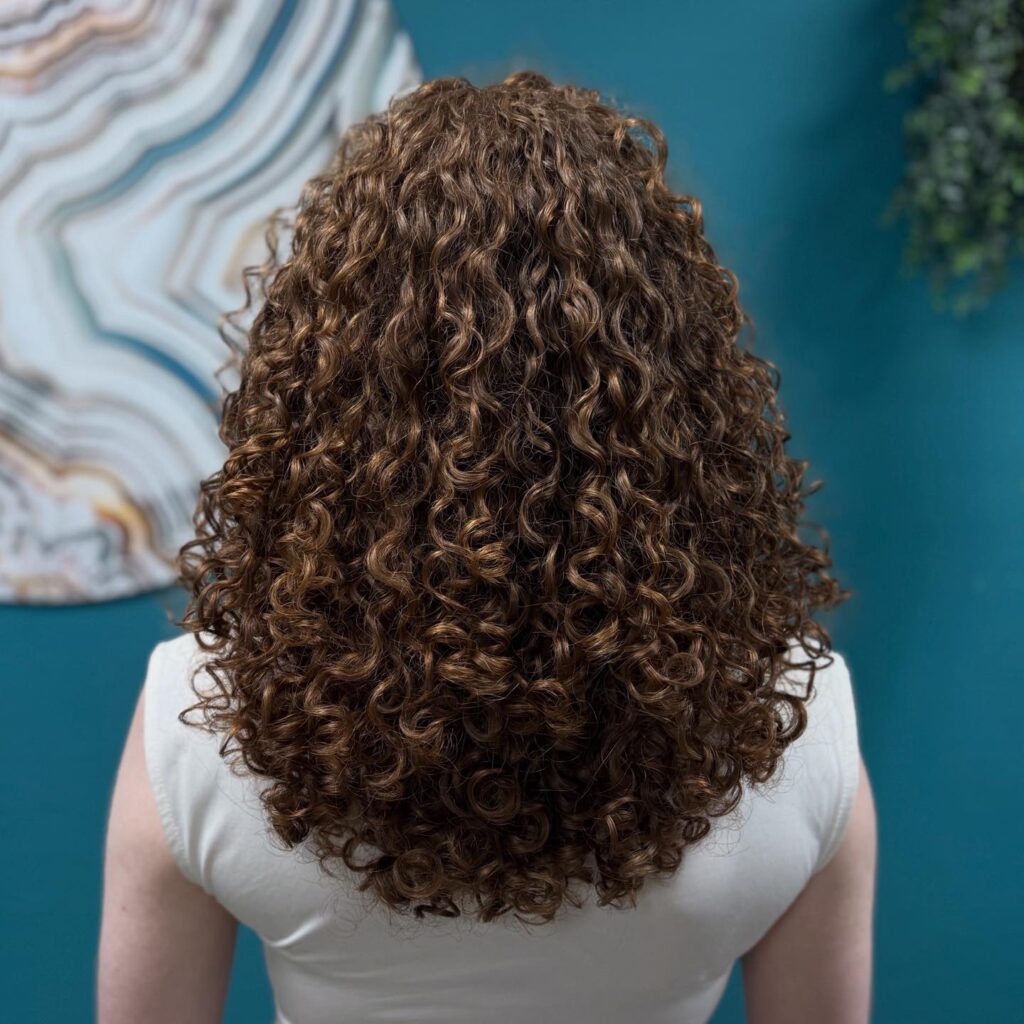
Cutting curly hair is not the same as cutting straight hair. Yet curls are still often treated as if they behave in the same way. The hair is wet down, combed straight and cut using a traditional technique. But once the hair dries, everything can change: the curls spring up, the shape becomes uneven or the haircut suddenly looks much shorter than expected.
That happens because curly hair moves differently, shrinks differently and responds differently to length, weight and styling. To cut curls well, you need to look beyond length. You need to understand shape, balance, curl pattern and the natural movement of the hair.
In this blog, you will learn why cutting curly hair requires a different approach from cutting straight hair.
Curly hair has shrinkage
One of the biggest differences between straight and curly hair is shrinkage. Straight hair usually falls down in a fairly predictable way. Curly hair behaves differently. A curl can look much longer when it is wet than when it is dry.
Some curls shrink only slightly. Others can spring up several centimetres. With tight curls and afro-textured hair, the difference between wet length and dry length can be significant.
This makes cutting curls more complex. If too much length is removed while the hair is wet, the final result can end up much shorter than intended. That is why it is so important to understand how much the hair shrinks and how it naturally falls when dry.
Every curl falls differently
With straight hair, it is often easier to see whether the length is even. With curly hair, this is much less straightforward. Not every curl has the same shape, thickness or spring. Even on one head, several curl patterns can be present.
The front may be looser than the back. The underneath layers may curl more tightly than the top layers. Some sections may create volume, while others fall flatter.
That is why cutting curly hair requires a visual approach. You do not only look at centimetres. You look at the overall shape:
- Does the hair have balance?
- Is the volume in the right place?
- Does the shape feel soft, natural and wearable?
- Are some areas too heavy or too short?
Cutting curls is less about creating perfectly straight lines and more about shape, movement and feeling.
Wet cutting does not always show the real result
Many traditional cutting techniques start on wet hair. For straight hair, this often works well because the hair usually falls in a similar way when wet and dry. With curls, that is not always the case.
Wet hair is heavier. This stretches the curls and makes the hair look longer. Only when the hair is dry can you see the real curl pattern, the true volume and the natural shape.
That is why many curl specialists choose to cut curly hair dry. When you cut curls dry, you can immediately see how the curls fall naturally. You can judge each curl and decide what is needed to create shape, balance and movement.
This does not mean that curly hair can never be cut wet. But it does mean that you always need to consider the difference between wet length and dry shape.
Curls respond strongly to weight
Curly hair reacts strongly to weight. When the hair is too heavy, the curls can stretch out and lose volume. This often creates a triangular shape: flat at the roots and wide at the bottom.
But if too much weight is removed, the hair can become frizzy, uneven or too springy. Over-thinning can also cause problems. The curls may lose their structure and stop clumping nicely together.
When cutting curly hair, balance is everything. You want to keep enough weight for the curls to fall beautifully, while also creating enough lightness for movement and volume.
Shape matters more than length alone
With straight hair, the focus is often mainly on length: blunt, layered, one-length or shaped around the face. With curly hair, shape is just as important as length.
A small adjustment in the right place can make a big difference. It can create more volume, a softer outline or a better frame around the face.
That is why a good curly haircut does not start with cutting. It starts with observing. How does the hair fall? Where is the volume? Where is the shape missing? Which areas are too heavy? Which curls spring up more than others?
A good curly cut is adapted to the hair itself and to the person wearing it.
Care and styling influence the final result
With curls, the result does not end after cutting. Care and styling are just as important. A good haircut may not show its full potential if the hair is washed, styled or dried in the wrong way afterwards.
Curly hair often needs moisture, definition and the right drying technique. Product choice also makes a difference. Products that are too heavy can pull curls down, while too little styling can lead to frizz and lack of definition.
That is why cutting curly hair also requires knowledge of curl care and styling. You need to understand how to help the hair fall beautifully after the cut.
In the Online Curly Hair Cutting Course, you do not only learn cutting techniques. You also learn about curl care, styling and drying, because that combination is what creates the best final result.
Why many people with curls have bad haircut experiences
Many people with curls know this experience: they go to the salon, ask for just a small trim and leave with much shorter hair than expected. Or the hair looks fine in the salon, but after the first wash it falls completely differently.
This usually does not happen because the stylist does not care. It often happens because curly hair requires specific knowledge. Many traditional hairdressing courses focus mainly on straight or slightly wavy hair, while curls need a different level of understanding.
A stylist who wants to cut curls well needs to understand how curly hair responds to:
- shrinkage
- moisture
- weight
- layers
- density
- elasticity
- porosity
- styling
Only when you understand these properties can you make better decisions while cutting.
Cutting curly hair requires trust
People with curls are often careful with their hair. That makes sense, especially if they have had disappointing salon experiences before. A good curl specialist therefore needs more than technical skill. They also need to listen carefully.
A clear consultation is essential. What does the client want? How do they usually wear their hair? Do they wear it naturally curly? How much length can really be removed? What is their styling routine at home?
By looking carefully and asking the right questions before cutting, you prevent disappointment. Cutting curly hair requires trust, patience and communication.
Learning to cut curly hair online
Because cutting curls is such a specific skill, focused training can make a big difference. Not every stylist learns this in depth during hairdressing school. Even if you already work with curls, extra knowledge can help you cut with more confidence and structure.
With the Online Curly Hair Cutting Course by KrullenTemmer, you learn step by step how to understand and cut curls better. You can follow the lessons at your own pace, from home or from your salon.
The course is suitable for hairdressers, hairstylists and curly hair professionals who want to feel more confident when cutting, caring for and styling curly hair.
You will learn about:
- recognising different curl types
- hair properties such as porosity, elasticity and density
- the importance of dry cutting
- creating shape and balance
- curl care and styling
- drying and finishing curly hair
- giving better advice to curly-haired clients
Who is the Online Curly Hair Cutting Course for?
This course is especially useful for hairdressers, hairstylists and curly hair professionals who want to expand their knowledge. It is also a great fit if you already work with curls but want more structure, technique and confidence.
You do not have to learn everything at once. The benefit of online learning is that you can pause, rewatch and practise at your own pace.
This allows you to build your confidence step by step.
Conclusion: curls need their own approach
Cutting curly hair is different from cutting straight hair because curls fall, shrink and respond to weight and styling in their own way. Curly hair should not be treated like straight hair with a wave. It requires its own technique, a trained eye for shape and a good understanding of natural curl movement.
When you learn how to cut curls properly, you can help clients achieve a haircut that works with their natural texture instead of against it. That is what makes the difference: not just a standard haircut, but a shape that enhances the curls.
Would you like to learn how to cut, care for and style curls professionally?
Discover the Online Curly Hair Cutting Course by KrullenTemmer and learn step by step how to work with curly hair with more knowledge and confidence.