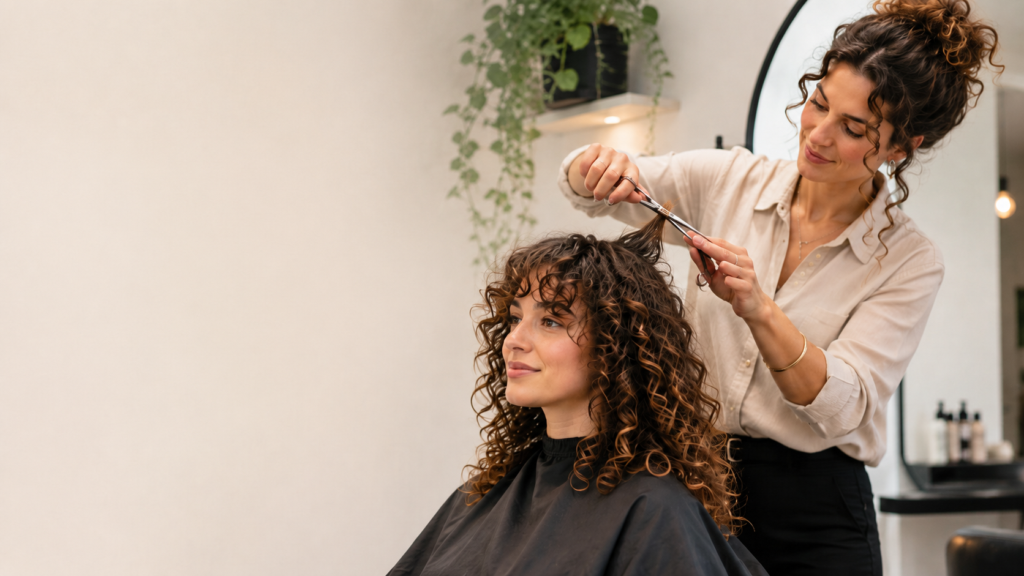
Cutting curly hair requires a different approach from cutting straight hair. While straight hair is often cut wet, this does not always work well for curls. Curly hair changes a lot when it becomes wet. It becomes heavier, the curl stretches out and the length often appears longer than it actually looks when dry.
That is why many curl specialists choose to cut curly hair dry. When the hair is dry, you can see how the curls truly fall. You can see the natural shape, the amount of volume, the shrinkage and the areas where the haircut may be out of balance.
In this blog, I explain why dry cutting curly hair often works better and what you need to pay attention to.
Curls fall very differently when dry than when wet
One of the main reasons to cut curls dry is that curly hair falls differently when wet and dry.
When curly hair is wet, it becomes heavier. This weight stretches the curls, making the hair look longer and straighter than it will be once it dries. As soon as the hair dries, the curls spring back up.
That difference can be significant. With wavy hair, it may only be a few centimetres, but with tight curls or afro-textured hair, the shrinkage can be much greater.
If you cut curls wet without taking shrinkage into account, the final result can become shorter than intended. This is one of the reasons why people with curls are sometimes disappointed after a haircut.
Dry cutting helps prevent this, because you can immediately see how long the hair actually appears when it falls naturally.
You can see the natural shape of the hair
With curls, a haircut is not only about length. It is mainly about shape. A good curly cut helps the curls fall beautifully, gives the right amount of volume and creates balance in the overall style.
When the hair is wet, that shape is often harder to see. The curls are stretched, the volume disappears and the hair lies closer to the head. This makes it more difficult to judge where the hair is too heavy or where shape is missing.
When cutting curls dry, you can immediately see:
- how the curls fall naturally
- where the volume sits
- where the hair looks too heavy
- where the shape is out of balance
- which curls spring up more or less
- how the front falls around the face
This allows you to cut more precisely. You are not only cutting for length, but for the overall shape.
Dry cutting helps you understand shrinkage
Shrinkage is one of the biggest challenges when cutting curly hair. One curl may shrink much more than another. Even on one head, different curl patterns can be present.
Some strands around the face may be looser, while the curls at the nape or underneath layers may curl much tighter. If everything is cut wet at the same length, it may look uneven once dry.
With dry cutting, you can immediately see which curls spring up more. This helps you decide how much to cut in each section.
The result is often more natural and better suited to the hair itself.
You reduce the risk of cutting off too much length
Many people with curls are careful about losing length. That is understandable, because a small trim can look much shorter once the hair dries.
With wet cutting, the risk of removing too much length is greater. The stylist sees a longer, stretched version of the hair. Only after drying does it become clear how much length is actually left.
Dry cutting gives more control. You can see immediately what every cut does to the shape and length. This allows you to work step by step and check along the way whether more needs to be removed.
For clients, this often creates more trust because they can see what is happening during the cut.
Dry cutting makes personalised cutting possible
No curl is exactly the same. That is why a standard cutting technique does not always work well for curly hair.
With dry cutting, you can work much more personally. You can look at each curl or section and see what it needs. One curl may only need a tiny trim, while another section may need a little more correction to fall beautifully into shape.
This makes dry cutting especially suitable for:
- curly hair with different curl patterns
- hair that quickly loses its shape
- hair with a lot of shrinkage
- hair that appears uneven
- clients who wear their natural curls
- haircuts where shape and volume are important
A good curly cut is not a standard haircut. It is personalised work.
Volume and balance are easier to see
Many people with curls want more volume, but in the right places. Too much volume at the bottom can create a triangular shape. Too little volume on top can make the hair look heavy and flat.
When the hair is wet, you often cannot see this volume clearly. Only when the hair is dry can you see how the shape builds up and where the hair is too heavy or too flat.
With dry cutting, you can judge the balance more accurately. For example, you can see whether more lightness is needed around the crown or whether more shape is needed at the sides.
This creates a haircut that suits the natural movement of the hair.
Dry cutting is not the same as randomly cutting into dry curls
Dry cutting may sound simple, but it requires knowledge and technique. It does not mean randomly cutting off loose pieces of hair.
A curl specialist first looks carefully at the hair. How does it fall? How does the client normally wear it? Where is the shrinkage? Where is the volume? Which areas are too heavy? Which curls need more space?
Only then is the hair cut carefully, often in small steps. The goal is to create shape without disturbing the curl pattern.
Dry cutting requires understanding of:
- curl types
- hair properties
- shrinkage
- density
- elasticity
- porosity
- shape building
- styling results
That is why focused training is important if you want to learn how to cut curls professionally.
When can wet cutting be useful?
Although dry cutting often works well for curls, this does not mean wet cutting is always wrong. Sometimes wet cutting can be useful, for example for certain technical corrections or when the hair needs to be reshaped first.
A combination of dry and wet cutting can also be suitable in some cases. The most important thing is that the stylist understands what the hair does in both states.
With curls, it is not about one fixed rule. It is about observing, judging and adapting to the hair.
Still, for many curly cuts, the natural dry fall of the hair is an important starting point. Because that is how the client actually wears their hair.
Care and styling remain important
A good cutting technique is important, but with curls, care and styling also determine the final result.
If the hair is washed incorrectly, styled with products that are too heavy or dried in the wrong way, even a good haircut may not show its full potential.
That is why it is important to understand not only dry cutting, but also which products, routines and drying techniques suit the hair.
In the Online Curly Hair Cutting Course by KrullenTemmer, you learn not only how to cut curls, but also how to care for, style and dry them. It is this combination that creates a beautiful and professional final result.
Learn dry cutting for curly hair online
Do you want to feel more confident as a hairdresser, hairstylist or curly hair professional when cutting curls? Then it is valuable to learn why dry cutting works and how to apply this technique properly.
With the Online Curly Hair Cutting Course, you learn step by step how to analyse and cut curly hair. You learn how to look at shape, balance, hair properties and natural fall.
The course is online, so you can learn in your own time and at your own pace. You can rewatch the videos, pause the lessons and practise whenever it suits you.
You will learn, among other things:
- why curls are often cut dry
- how to assess shrinkage more accurately
- how to create shape and balance
- how to approach different curl types
- how hair properties influence the result
- how care, styling and drying affect the final look
Conclusion: dry cutting gives a clearer view of the real curl
Dry cutting often works better for curly hair because you see the hair as it truly falls. You can see the natural shape, volume, shrinkage and balance of the haircut.
With curly hair, this is important because wet hair can give a distorted view. Curls stretch, appear longer and spring back up once dry. By cutting the hair dry, you can work more accurately and adapt the cut to the natural movement of the hair.
Would you like to learn how to dry cut curls professionally and create shape, volume and balance?
Discover the Online Curly Hair Cutting Course by KrullenTemmer and learn step by step how to cut curly hair with more knowledge and confidence.